
| Quick Answer: How Often Should You Worm Your Dog? Puppies 2 to 12 weeks old: Every 2 weeks Puppies 3 to 6 months old: Once a month Adult dogs 6 months and older: Every 3 months (4 times per year) High-risk dogs (outdoor, raw-fed, multi-pet): Every 1 to 2 months Pregnant dogs: Before mating and at day 40 to 45 of pregnancy Nursing dogs: At whelping and again at 2 and 4 weeks post-birth Source: CAPC Guidelines | AAHA Parasite Prevention Guidelines |
Most dogs with worms don’t look sick at first, which is why the problem is easy to miss. From my own experience, that’s one of the biggest mistakes dog owners make — waiting for visible signs. So how often dog worming should happen depends on your dog’s age, lifestyle, and risk level.
For most adult dogs, the answer is every three months. Puppies, pregnant dogs, and higher-risk dogs may need a different schedule, which is why it helps to know the right timing for your dog specifically.
In this guide, you will learn exactly how often you should worm your dog based on their life stage and risk level. You will get a vet-aligned worming schedule, a complete breakdown of treatment options available in the USA, answers to the most common questions dog owners search for, and a downloadable reference guide you can keep handy.
Video credit: Pet Circle via YouTube.
Table of Contents
Why Regular Dog Worming Matters
Regular dog worming is one of the simplest and most impactful things you can do for your pet’s long-term health. Worms are internal parasites that live inside your dog’s digestive tract, heart, lungs, or muscles, depending on the type. They steal nutrients, cause tissue damage, and in serious cases can be fatal, especially in young puppies or dogs with weakened immune systems.
The most common intestinal worms found in US dogs are roundworms (Toxocara canis), hookworms (Ancylostoma caninum), whipworms (Trichuris vulpis), and tapeworms (Dipylidium caninum and Taenia species). Heartworm is a separate and serious parasite covered by monthly preventives, not standard gut wormers.
Most Infected Dogs Look Completely Healthy
This is the part most dog owners find surprising. Many dogs carrying a significant worm burden look, eat, and act totally normal. Worms are often only detected through routine fecal testing at the vet. This is exactly why a consistent how-often-dog-worming schedule is so important. You are not just reacting to a visible problem. You are preventing one before it starts.
According to CAPC prevalence data, the roundworm Toxocara canis was detected in approximately 30% of dogs tested at US veterinary practices. Hookworm prevalence was highest in the southeastern United States due to the warm, humid soil conditions that allow larvae to survive year-round.
The Risk to Human Health Cannot Be Ignored
Some dog worms can infect people. Roundworm eggs shed in dog feces can survive in garden soil for two or more years. The CDC identifies Toxocara canis as a leading cause of visceral larva migrans in the United States, a condition in which roundworm larvae migrate through human organs. Children who play in contaminated soil are at the highest risk. This makes keeping your dog on a regular deworming schedule a public health priority, not just a personal pet care choice.
Tapeworms can also occasionally infect humans, though this is less common and usually requires accidentally swallowing an infected flea. A consistent worming and flea control routine eliminates this risk almost entirely.
How Often Should Dogs Be Wormed by Age
The most accurate answer to how often should dogs be wormed depends on your dog’s current life stage more than almost any other factor. Puppies are born into a world of worm exposure, often infected before they even open their eyes. Adults need maintenance treatment. Senior dogs need the same frequency but may require product adjustments.
Puppy Worming Schedule: Birth to 6 Months
Puppies face the highest worm risk of any life stage. Roundworms and hookworms are routinely passed from mother to puppy through the placenta during pregnancy and through milk during nursing. This is not a failure of care. It is simply how these parasites work, and it is why puppies need such a front-loaded worming schedule.
The American Animal Hospital Association (AAHA) and CAPC both recommend the following for puppies:
- Begin deworming at 2 weeks of age
- Repeat every 2 weeks until 12 weeks old
- Then worm once a month from 3 months to 6 months of age
- After 6 months, move to the adult schedule of every 3 months
Most vets use pyrantel pamoate or fenbendazole (sold as Safe-Guard or Panacur) for puppies. These are safe for very young dogs and effective against the roundworms and hookworms most commonly seen in puppies. Always dose based on your puppy’s current weight, which changes rapidly in the first few months of life.
Adult Dog Worming Schedule: 6 Months to 7 Years
For healthy adult dogs living a fairly typical lifestyle, how often should you worm a dog? The answer is four times per year. That means one treatment every three months, ideally timed to the change of seasons: spring, summer, fall, and winter.
This quarterly schedule is the standard recommendation from the CAPC and is consistent with guidance from the American Veterinary Medical Association (AVMA). It accounts for the time it takes for any new worm infection to mature to the point where it causes real harm, giving you a comfortable protective window without over-treating.
A good habit is to tie your dog’s worming to another seasonal routine. Many owners worm their dogs at the same time as their own seasonal tasks, such as starting spring yard work or preparing for winter. This kind of association makes it almost impossible to forget.
Senior Dog Worming Schedule: 7 Years and Older
Senior dogs follow the same every-three-months schedule as healthy adults. However, older dogs with compromised immune function, kidney disease, liver conditions, or significant weight loss may need a modified approach. Some deworming products require dose adjustments for dogs with organ impairment. Always check with your vet if your senior dog has any ongoing health conditions before choosing a product.
It is also worth noting that senior dogs who have spent years on a consistent worming schedule typically have a lower worm burden overall than dogs whose protection has been inconsistent. Consistency over years pays off significantly.
Puppy vs Adult Worming Frequency at a Glance
Life Stage | Age Range | Worming Frequency | Recommended Product Type |
Newborn puppy | 2 to 12 weeks | Every 2 weeks | Pyrantel pamoate or fenbendazole |
Young puppy | 3 to 6 months | Once a month | Pyrantel pamoate or fenbendazole |
Adult dog | 6 months to 7 years | Every 3 months | Broad-spectrum wormer |
Senior dog | 7 years and older | Every 3 months (vet review) | Vet-recommended product |
High-risk adult | Any adult age | Every 1 to 2 months | Broad-spectrum combo |
Pregnant dog | During pregnancy | Pre-mating and day 40 to 45 | Vet-prescribed only |
Nursing dog | Post-birth | At whelping, 2 and 4 weeks | Vet-prescribed only |
How Often to Flea and Worm a Dog Together
A question that comes up constantly is how often to flea and worm a dog at the same time. The practical answer depends on which products you are using, but the ideal is to have both covered in a single monthly routine.
Several prescription combination products available in the USA handle fleas, heartworm prevention, and multiple intestinal worms in one monthly chewable. If your dog is on one of these monthly prescriptions, you are already deworming every 30 days, which exceeds the minimum quarterly recommendation for most dogs.
Monthly Combination Products vs Quarterly Standalone Wormers
Neither approach is wrong. Here is how to choose between them:
- Go for the monthly combo if your dog has outdoor access, lives with other pets, eats a raw diet, or attends dog parks. The added flea and heartworm coverage justifies the cost.
- Go quarterly standalone if your dog is low risk, lives primarily indoors, and you already have separate flea control in place. A good over-the-counter broad-spectrum wormer four times a year is perfectly adequate.
- Always maintain heartworm prevention regardless of which intestinal worming approach you choose. Heartworm is a separate parasite with its own monthly preventive, and it is not covered by most standard gut wormers.
One important clarification that confuses many owners: standard flea products like Frontline, Advantage, or K9 Advantix do NOT deworm your dog. Flea treatment and intestinal worming are separate categories. A dog on a monthly flea product alone is not protected against roundworms, hookworms, or whipworms without an additional wormer or a true combination product.
How Often Can I Give My Dog Worm Medicine When Using Combos
If your vet has prescribed a monthly combination product, give it every 28 to 30 days as directed. Do not add a separate standalone wormer on top of this without checking with your vet first. Certain active ingredients overlap between products, and while a single accidental double-dose is unlikely to be dangerous in a healthy adult dog, there is no benefit, and you should not make it a habit.
Risk Factors That Change How Often You Should Worm Your Dog
The standard every three-month recommendation is a starting point, not a one-size-fits-all answer. Your dog’s specific lifestyle, diet, and environment all influence how frequently they are exposed to worms and, therefore, how often they actually need treatment.
Dogs That Need More Frequent Worming
- Raw meat diet: Raw pork, rabbit, and wild game carry tapeworm larvae. Most vets recommend monthly worming for raw-fed dogs with a product that specifically covers tapeworms.
- Hunting or scavenging behavior: Dogs that eat dead wildlife, rabbits, or rodents face significantly higher tapeworm exposure than dogs that do not. Dogs that regularly eat earthworms, bugs, or other yard material face increased parasite exposure. See our full guide on what happens when a dog eats earthworms and what risks to watch for.
- Multi-pet households: Worms spread easily between dogs sharing the same yard and water bowl. If one dog has worms, all pets in the home should be treated simultaneously.
- Dog parks and daycare: High-density dog environments increase exposure to fecal contamination and therefore worm transmission.
- Warm climate and outdoor access: Southern US states have higher year-round worm larval activity in soil. Dogs in Florida, Texas, Georgia, and similar states face greater persistent exposure than dogs in northern states during winter months.
- Working dogs and farm dogs: Regular soil exposure and contact with livestock dramatically elevate all worm risks, particularly hookworm and whipworm.
How Often Should You Worm a Dog on Raw Food
For raw-fed dogs, the standard three-month schedule is generally considered insufficient. Most veterinary parasitologists recommend every four to six weeks for dogs on a raw or partially raw diet. The reason is tapeworm risk from meat containing Taenia or Echinococcus larvae, which are not reliably killed by standard household refrigerator or freezer temperatures.
Any wormer used for a raw-fed dog must contain praziquantel to be effective against tapeworms. Products containing only pyrantel pamoate or fenbendazole may not cover all tapeworm species. Check your product label carefully or ask your vet which product gives you full coverage for your dog’s diet.
Do Indoor Dogs Still Need Worming?
Yes, absolutely. Even dogs that rarely leave the house are not zero risk. Worm eggs can be tracked indoors on shoes and clothing. Dogs pick up worm exposure on their daily walks, even when they have no contact with other dogs. Fleas inside the home transmit tapeworm larvae. Insects caught inside the house can carry larvae. The risk is lower for indoor dogs, but it is not zero, and the standard every-three-months schedule remains the appropriate recommendation.
How Often Can I Give My Dog Worm Medicine Safely
One of the most common concerns dog owners have is whether giving worm medicine too often is harmful. The honest answer is that standard licensed dewormers have a wide safety margin, and treating slightly more frequently than necessary is unlikely to cause harm. But there are still good reasons to follow the recommended schedule rather than over-treating.
Can You Worm a Dog Too Often?
In practical terms, giving an adult dog an extra dose a few weeks early from a standard OTC wormer is not dangerous. These products are designed with safety margins that account for accidental overdosing. However, there are two legitimate reasons not to over-treat unnecessarily:
- Parasite resistance risk: Overuse of any antiparasitic drug over time creates selection pressure on worm populations. Resistance to dewormers is well established in livestock parasites, and multiple-drug-resistant hookworm (Ancylostoma caninum) has now been confirmed in domestic dogs in the USA, according to peer-reviewed research published in PLOS Pathogens (Venkatesan et al., 2023). While not yet a widespread clinical problem across all worm types, responsible treatment frequency is increasingly recommended by veterinary parasitologists.
- Treatment does not prevent reinfection: Deworming kills existing worms but provides no residual protection. Treating more often than the life cycle of the parasite requires does not give better protection. The quarterly schedule is timed to interrupt the worm life cycle at the right point.
What Happens if You Deworm a Dog That Does Not Have Worms
If you treat a worm-free dog with a standard dewormer, the medication passes through their system and is eliminated without significant effect. The most common mild side effects in any dog, with or without worms, are temporary loose stools, mild lethargy, or reduced appetite for 24 hours or so. These side effects resolve on their own and are not a sign of a problem.
How Often Do Dogs Get Worming Tablets at the Vet
At a routine annual or biannual vet check, your veterinarian will typically recommend maintaining quarterly worming at a minimum. If your dog tests positive for worms on a fecal exam, the vet may prescribe a specific treatment course, which could be a single dose or daily doses for three to five days, depending on the worm type and product used. This treatment course is separate from and in addition to your regular maintenance schedule.
Types of Dog Worming Treatments Available in the USA
Understanding which product to use is just as important as knowing how often to worm your dog. Different wormers target different worm types. Choosing the wrong product can mean your dog is treated but still unprotected against certain parasites.
Over-the-Counter Dog Dewormers
These are available at pet stores and online retailers without a prescription. The three main active ingredients in OTC dog wormers in the USA are:
- Pyrantel pamoate: Found in products like Nemex-2 and many store-brand puppy wormers. Covers roundworms and hookworms. Safe from 2 weeks of age, making it the standard first choice for puppies. Does not cover tapeworms or whipworms.
- Praziquantel: Found in products like Tape Worm Tabs and D-Worm Combo. Specifically targets tapeworms. Often combined with pyrantel in combo OTC products for broader coverage.
- Fenbendazole: Sold as Safe-Guard Canine. Covers roundworms, hookworms, whipworms, and some tapeworm species (Taenia but not Dipylidium, the flea tapeworm). Available in granule and liquid forms. Typically given daily for three consecutive days for whipworm treatment.
Prescription Dog Dewormers and Combination Products
For full-spectrum coverage, including heartworm, you need a prescription from your vet. These monthly chewables or tablets are the most comprehensive option:
- Interceptor Plus (milbemycin oxime plus praziquantel): Monthly chewable tablet covering heartworm, roundworms, hookworms, whipworms, and tapeworms. One of the most comprehensive prescription options available.
- Sentinel Spectrum (milbemycin oxime plus lufenuron plus praziquantel): Monthly chewable tablet adding flea sterilization to the Interceptor Plus coverage. Does not kill adult fleas but prevents eggs from hatching.
- Simparica Trio (sarolaner plus moxidectin plus pyrantel): Monthly chewable covering heartworm, fleas, five tick species, roundworms, and hookworms. Popular for dogs needing tick coverage alongside parasite prevention.
- Trifexis (spinosad plus milbemycin oxime): Monthly chewable covering heartworm, fleas, roundworms, hookworms, and whipworms.
Product Name | Covers | Frequency | Rx Needed? |
Pyrantel pamoate (Nemex) | Roundworms, hookworms | Every 3 months | No |
Safe-Guard (Fenbendazole) | Round, hook, whip, some tape | Every 3 months | No |
D-Worm Combo | Round, hook, tapeworms | Every 3 months | No |
Interceptor Plus | Full spectrum plus heartworm | Monthly | Yes |
Sentinel Spectrum | Full spectrum plus fleas plus heartworm | Monthly | Yes |
Simparica Trio | Heartworm, fleas, ticks | Monthly | Yes |
Trifexis | Complete parasite protection | Monthly | Yes |
How Much Worm Medicine to Give a Dog
Every deworming product is dosed by body weight. Giving too few risks leads to treatment failure. Giving too many risks has side effects. Always weigh your dog before each treatment, especially for growing puppies.
As a general reference point, pyrantel pamoate is typically dosed at around 2.27 mg per pound of body weight for roundworms and hookworms. Fenbendazole (Safe-Guard) is dosed at 25 mg per pound of body weight for three to five consecutive days when treating whipworms. However, always follow the specific product label or your vet’s instructions, as dosing varies between products and by worm type being treated.
Signs Your Dog Needs Deworming Right Away
Even with a consistent schedule in place, it is worth knowing the signs that your dog may have an active worm infection that needs attention before the next scheduled treatment. Because many infections are subclinical, meaning they cause no obvious symptoms, a fecal test from your vet is more reliable than visual signs alone. But there are warning signs worth watching for.
Visible and Behavioral Signs of Worms in Dogs
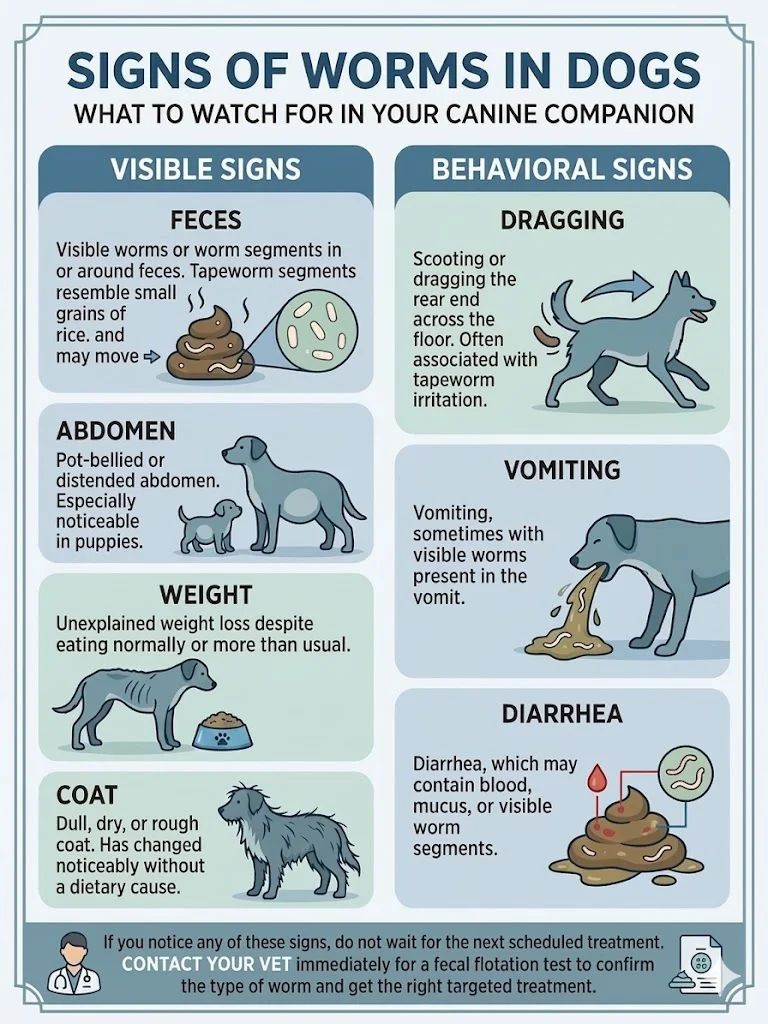
- Visible worms or worm segments in or around feces (tapeworm segments look like small grains of rice and may move when fresh)
- Pot-bellied or distended abdomen, especially noticeable in puppies
- Unexplained weight loss despite eating normally or eating more than usual
- Dull, dry, or rough coat that has changed noticeably without a dietary cause
- Scooting or dragging the rear end across the floor (often associated with tapeworm irritation)
- Vomiting, sometimes with visible worms present in the vomit
- Diarrhea, which may contain blood, mucus, or visible worm segments
- Persistent lethargy or low energy without another obvious cause
- Coughing, which can indicate migrating roundworm larvae or lungworm infection
If you notice any of these signs, do not wait for the next scheduled treatment date. Contact your vet for a fecal flotation test to confirm the type of worm and get the right targeted treatment.
What Kills Worms in Dogs Fastest
No dewormer works instantly, despite what some product marketing implies. Most licensed dewormers begin killing worms within a few hours, but the complete clearance takes 24 to 72 hours for most products. Praziquantel, used specifically for tapeworms, is among the fastest-acting and causes tapeworm disintegration within hours of a single dose. Fenbendazole works more gradually over a three to five-day treatment course, which is why it is given daily across multiple days for whipworm treatment.
How to Disinfect Your Home After Your Dog Has Worms
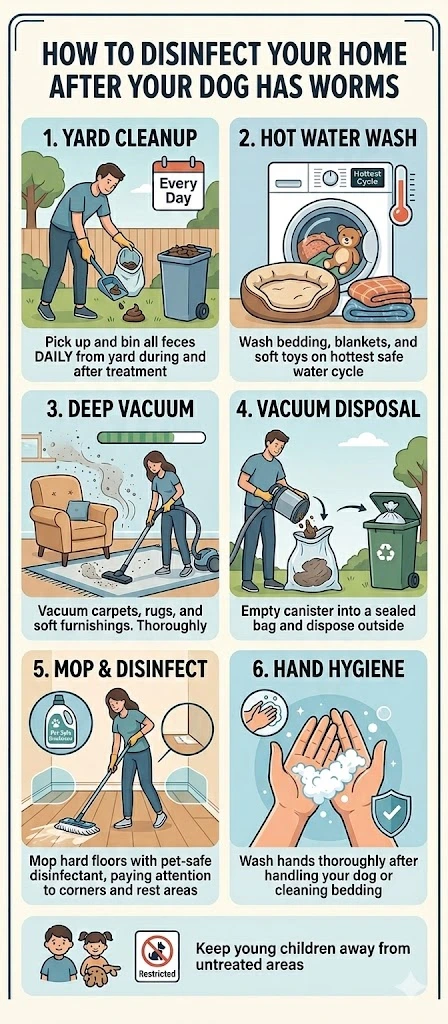
Treating your dog removes the worms from their body, but worm eggs can survive in your home environment for weeks or months. Here is the full decontamination routine:
- Pick up and bin all dog feces from your yard every day during and after treatment
- Wash all dog bedding, blankets, and soft toys on the hottest water cycle safe for the fabric
- Vacuum all carpets, rugs, and soft furnishings thoroughly, then immediately empty the vacuum bag or canister into a sealed bag and dispose outside
- Mop hard floors with a pet-safe disinfectant, paying attention to corners and areas where your dog rests
- Wash your hands thoroughly after handling your dog, cleaning up after them, or touching their bedding
- Keep young children away from areas where your dog defecates until the yard has been cleaned and the dog has completed treatment
Full Dog Worming Schedule Reference Table
Dog Type | Worming Frequency | Best Product Type | Key Notes |
Puppy 2 to 12 weeks | Every 2 weeks | Pyrantel pamoate | Weigh before every dose |
Puppy 3 to 6 months | Once a month | Pyrantel or fenbendazole | Dose increases as the puppy grows |
Adult dog (low risk) | Every 3 months | Broad-spectrum wormer | 4 times per year minimum |
Adult dog (high risk) | Every 1 to 2 months | Prescription monthly combo | Raw diet, outdoor, multi-pet |
Senior dog | Every 3 months | Vet-recommended product | Check for organ health first |
Pregnant dog | Pre-mating and day 40 to 45 | Vet-prescribed only | Never self-treat in pregnancy |
Nursing dog | At whelping, weeks 2 and 4 | Vet-prescribed only | Protects puppies via milk |
Indoor-only dog | Every 3 months | Broad-spectrum OTC wormer | Lower risk but still necessary |
Raw-fed dog | Every 4 to 6 weeks | Must include praziquantel | Tapeworm risk from meat |
FAQS: People Also Ask About How Often Dog Worming is needed and its treatment
How often should I worm my dog?
How often should you worm a dog at home?
How often can I give my dog worm medicine?
Do indoor dogs need worming?
How often do humans get worms from dogs?
What happens if I deworm my dog and they do not have worms?
Is there a natural way to worm dogs?
How often should you worm a dog on raw food?
Conclusion: Keeping Your Dog Worm-Free Year Round
Getting dog worming right does not need to be complicated. For most adult dogs in the USA, four treatments per year using a quality broad-spectrum wormer is entirely sufficient. Puppies need a more intensive schedule in those first six months. Dogs with higher-risk lifestyles need monthly coverage, ideally through a vet-prescribed combination product that covers fleas and heartworm at the same time.
The biggest mistake dog owners make is not getting the schedule wrong, but forgetting to maintain it consistently. An irregular worming history leaves gaps where worms can build up, cause harm, and in households with children, pose a genuine human health risk.
| 3 Key Takeaways From This Guide 1. Adult dogs need worming every 3 months. Puppies need every 2 weeks to 12 weeks, then monthly to 6 months. 2. Lifestyle changes the schedule. Raw-fed, outdoor, and multi-pet dogs need more frequent treatment. 3. Not all wormers cover all worms. Check your product covers tapeworms (praziquantel), roundworms, hookworms, and whipworms. |
If you are unsure which product or schedule is right for your dog, your veterinarian is always the best starting point. An annual fecal test combined with a year-round treatment schedule is the gold standard approach recommended by veterinary parasitologists across the USA.
Ready to go deeper? Read our complete guide to deworming puppies by age and weight, or learn about the safest wormers for pregnant and nursing dogs.
The content on this page is intended for general informational and educational purposes only. It is not a substitute for professional veterinary advice, diagnosis, or treatment. Always consult a qualified veterinarian for advice specific to your dog. If your dog is pregnant, nursing, under 8 weeks of age, or has an existing health condition, seek veterinary guidance before administering any deworming product.

Muhammad Saad writes about pet nutrition and safety at Petscriz, researching each topic against peer-reviewed and veterinary sources. Firsthand animal care experience includes freshwater fish, rabbits, cats, parrots, and chicks; dog-related content is compiled from cited research rather than personal ownership, and is flagged accordingly throughout the site.